Posts

Showing posts with the label Luminous

Gnosticism vs Christianity / Demiurge vs True God : From a Myth to the Highest Truth (Gnosis) ?

Image
Abstract: In the Abrahamic faiths, we often observe a clash between two foundational teachings: Gnosticism and Christianity/Catholicism. Gnosticism, with its emphasis on higher knowledge or "Gnosis", can be seen as controversial when compared to the other two teachings. Many Gnostic beliefs are considerably more liberal and diverge from traditional Abrahamic doctrines. This divergence can present both positive and negative implications.  However, a clear distinction exists between the central concepts of Gnosticism and those of other Abrahamic teachings. Gnosticism centers around the notion of a higher being known as the "Demiurge", whereas Christianity and Catholicism trace their roots to the forefather termed the "Supreme Creator" or "True God". Various religious narratives and mythologies have emerged surrounding these concepts; for practitioners and bodhisattvas, they represent authentic stories, milestones, and revelations along their evolut...
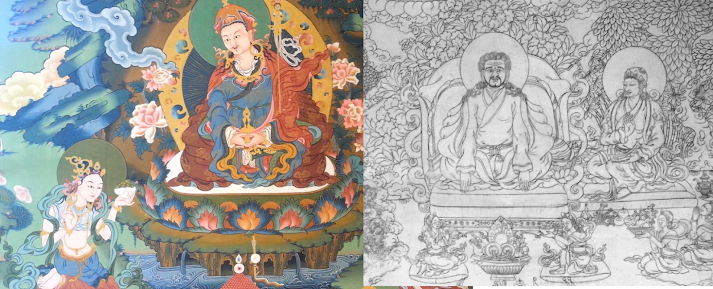
The 5th Seal : The Forgotten Seal of the Tantrika

Image
Abstract: Have you ever wondered why tantric practitioners live with their partners ? If the ultimate goal of Buddhism is renunciation, why do certain Maha-(Tantra)-yana traditions allow practising with a consort ? How can we justify Guru Padma's decision of being with  his consort  Mandāravā/Yeshe ? Is it why some people call this a distorted version of Buddhism or is there a deep esoteric reason behind this ? Does being with a partner accelerate the enlightenment process like it worked out well for early mahasiddhas ? Do Theravada and  Maha-(Tantra)-yana traditions finally converge ? We try to find answers to these questions in this article......... Fig. 1: Guru Padma and Marpa with their partners. In both Guru Saraha 's Mahamudra and Guru Padma 's Tantric traditions, we find many practitioners as non-monastic or domestic yogis who diligently engaged in their practices with consorts, partners and families as ordinary people. However their realization was ...

Non-Physical Beings: Lower Dimensions (Root cause of their existence ?)

Image
Abstract: In many religious traditions, scripts, we often hear about various kinds of non-physical beings. They are from both lower and higher dimensions. Beings from lower dimensions are typically labeled as dark beings who may appear before the bodhisattva as obstacles, to disturb his meditation. Many practitioners nowadays believe that these are just merely stories, mind made and mythical, but to the one who progressed through bodhisattva path, these obstacles have to be faced. In some cases, encountering, channeling them is an integral part of the practice. In fact it is a duty of the bodhisattva to clarify certain spiritual matters to these confused souls, even sharing his healing energy with them. This article brings forth the author's experiential insights on this matter.      We say that, the bodhisattva's service is both worldly and non-worldly. In non-worldly aspect, the adept has to accept things he does not like, things he did not imagine to exist. Especially ...

Self vs No-Self: Are They Really Opposing Ideas ?

Image
Abstract: Most Abrahamic and Indian traditions emphasize realizing the "Self" nature of the individual. On the contrary, Buddhism thrives to realize "No-Self" nature. They seem to be contradictory in their definitions and names. But we learnt that we share the same human body, mind and energy system despite the religious background we come from. Then there should not be two types of liberations, and this article brings some light and wisdom by demystifying these concepts, that clears up the confusion.     Gautham Buddha's teaching has flourished throughout the Asia, reaching out to the lands of far east. Some people even fight over the birthplace of Buddha, proclaiming he was originally from their home countries (i.e. Sri Lanka and Iran) even by presenting historical accounts and archeological evidences. However Buddha's main teaching is to let him born within ourselves, turning our hearts to be the ground where a lotus can bloom. Turning our gross minds to...

Intellectual vs Experiential Understanding

Image
Abstract:  Understanding everything written so far in this blog, intellectually is not a big deal. Our human mind has the potential to contemplate, re-derive, re-define concepts, philosophies and everything. They all sound true and convincing at the same time to the "mind". This is due to the relative and interdependent nature of the concepts and mind. For instance, it is not difficult to understand the duality and non-duality even without any meditative experience, within the limitation of our consciousness. However that understanding is with respect to the "mind". Why this is not so fulfilling? This article sheds some light on that. This is a conversation between a Zen master (not a teacher) and a disciple.  Disciple: Master, I understand the concept of duality and non-duality. It is not so difficult to grasp. Now what ? Master: Could you please give me an example ?  Disciple: Basically the difference between opposite polarities, such as male-female, hot-col...

Does God Exist ? Or is it Dependent Origination ?

Image
Abstract: In this post we will look at the creation in terms of our inner world .  How a meditator would see this creation without falling into any belief system? Meditator starts his journey based around a certain belief, a fixed practice at the beginning. With progression, his life starts to unshackle from certain identities, labels, pre-conditioned concepts and therefore freedom from any false identities, even from his own practice and meditative experience. At some point he starts to live by his own truth which is the reflection of his inner world.    When we refer to the creation of this universe/existence, the idea of the creator inevitably comes into the surface. Therefore certain spiritual traditions developed around this concept defines an omnipresent creator and signifies the importance of being one with him. On the contrary, the traditions around atheism signifies transcending ourselves, from our limited human capacity to a universal possibility. The secon...